
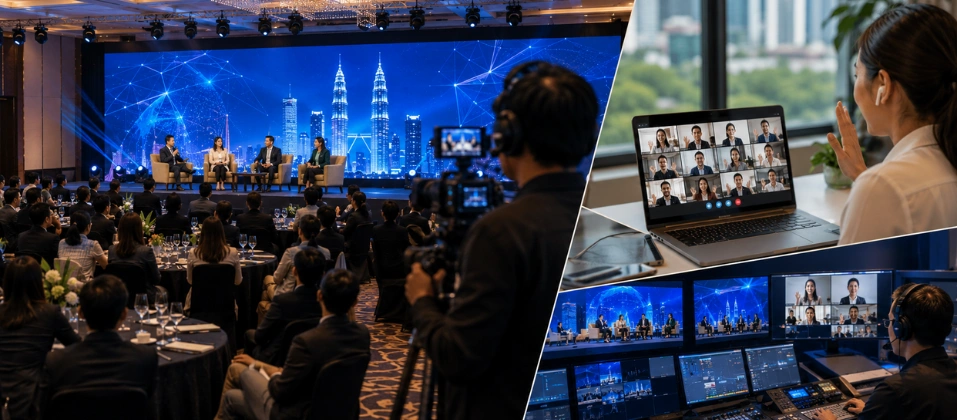
How to Organise a Hybrid Event That Engages Both Online and In-Person Audiences
July 2, 2026
A hybrid event combines a physical venue experience with a live virtual component, allowing both in-person and online audiences to participate in the same event simultaneously. Organising a hybrid event that genuinely engages both groups requires careful programme design, the right technology stack, and a deliberate strategy for keeping remote attendees connected and active throughout. This guide walks through the essential steps, tools, and best practices for planning a hybrid event that works for everyone in the room and everyone watching from outside it.
Introduction
Hybrid events have grown from a temporary solution into a format that many organisations now plan by choice. They give businesses the ability to reach audiences that geography, budget, or schedule constraints would otherwise prevent from attending, while still delivering the value of a live, in-person experience for those who can be there.
But hybrid events are not simply a live stream running beside a physical gathering. When treated that way, the online audience quickly feels like an afterthought. Truly effective hybrid events are designed from the start to serve two audiences at the same time.
Any experienced Event Management Company in Kuala Lumpur will tell you that hybrid planning is a distinct discipline. It requires separate but integrated strategies for each audience group, and a production setup that supports both simultaneously. This guide covers everything you need to know to get it right.
What Is a Hybrid Event?
A hybrid event is any gathering that combines a physical in-person experience at a venue with a live virtual component allowing remote participants to attend online in real time.
The format can be applied across a wide range of event types, from corporate conferences and product launches to training sessions, award ceremonies, exhibitions, and town halls. What defines a hybrid event is not the technology used, but the deliberate design of a shared experience for two different types of attendance.
|
Factor
|
DIY Planning
|
Professional Event Planner
|
|---|---|---|
|
Corporate Conference
|
Keynotes, breakout sessions, networking
|
Livestream, virtual Q&A, online polls
|
|
Product Launch
|
Live demos, media engagement, brand activations
|
Global livestream, interactive digital showcase
|
|
Trade Exhibition
|
Physical booths, product demos, networking
|
Virtual booths, online meeting scheduling
|
|
Training and Workshop
|
Hands-on sessions, small group activities
|
Live video participation, digital breakout rooms
|
|
Award Ceremony
|
Physical presentations, gala experience
|
Livestream voting, real-time celebration online
|
|
Annual General Meeting
|
Shareholder engagement, live voting
|
Remote participation, digital proxy voting
|
|
Town Hall
|
Leadership communication, live discussion
|
Remote staff participation, live Q&A
|
Why Hybrid Events Are Worth the Effort
Before diving into the how, it helps to understand what hybrid events offer that pure in-person or virtual events cannot.
Key advantages include:
- Wider audience reach. Participants who cannot travel or attend physically can still join and contribute in real time.
- Flexible attendance options. Attendees choose how they want to participate, which increases overall registration numbers.
- Increased sponsorship value. A larger total audience is more attractive to sponsors and partners.
- Content longevity. Hybrid events are recorded by nature, giving you content to repurpose and redistribute after the event.
- Cost efficiency. Online participants do not require catering, venue space, or travel logistics, reducing the per-head cost significantly.
Pro Tip: Track attendance split (in-person vs online) across your events over time. This data helps you justify the hybrid model to stakeholders and refine your production investment with each event.
The Unique Challenges You Need to Plan Around
Understanding the challenges upfront helps you design around them rather than react to them on the day.
The biggest challenge in hybrid events is engagement imbalance. In-person attendees have the energy of a physical room, direct speaker interaction, and the social benefit of being present. Remote attendees can feel passive or disconnected if their participation is not actively designed into the programme.
Other common challenges include:
- Technology failures such as stream drops, audio lag, or screen-sharing issues
- Time zone differences when remote audiences span multiple countries
- Unequal networking opportunities for virtual participants
- Content that is not formatted for both screen and in-room consumption simultaneously
- On-day team coordination between the physical event crew and the virtual broadcast team
Pro Tip: Run a full hybrid simulation at least one week before the event. Invite two or three remote team members to attend as virtual participants and report honestly on what the online experience feels like from their side.
Step-by-Step Guide to Organising a Hybrid Event
Step 1: Define Your Audience Split and Objectives Early
Before any planning begins, clarify the expected breakdown between in-person and online attendees. This single decision drives your venue size, technology budget, platform selection, and programme design.
Also define what success looks like for each audience group separately. In-person attendees may prioritise networking and live interaction. Online attendees may value content access, flexibility, and the ability to participate from anywhere. Both groups deserve a clearly defined value proposition.
Questions to answer at this stage:
- What percentage of your audience is expected to attend online?
- Are online attendees in different time zones?
- What level of interaction do you want online participants to have?
- Will online attendees need access to the same content as in-person guests?
Pro Tip: Survey your audience before confirming the format. Knowing how people plan to attend helps you allocate budget accurately and avoid over- or under-investing in either the physical or virtual experience.
Step 2: Choose the Right Venue and Technology Setup
The venue for a hybrid event needs to support two productions running simultaneously: the physical event and the virtual broadcast. This means prioritising venues with strong and reliable Wi-Fi infrastructure, good acoustic control, appropriate camera positions, and sufficient technical capacity.
Key technology components to plan for:
- Professional live streaming equipment and a dedicated broadcast streaming platform
- Multiple camera angles to give remote viewers a compelling and varied visual experience
- High-quality audio capture that works clearly for both in-room and online participants
- Interactive tools including live polling software, Q&A platforms, and virtual chat features
- Reliable primary internet with a backup connection to protect against outages
- Event registration and access management software that handles both audience types
For the physical side of the setup, experience in Indoor Event Management KL ensures the venue layout, stage design, and in-room logistics are all configured to support a hybrid broadcast rather than a traditional in-person-only format.
Pro Tip: Assess every potential venue against a hybrid-specific checklist, not a standard events checklist. Many venues that work beautifully for traditional events fall short on internet capacity or acoustic control once a broadcast is introduced.
Step 3: Design the Programme for Two Audiences at Once
One of the most important decisions in hybrid planning is how the programme is structured. Not all content translates equally well to a virtual format, and not all online engagement tools integrate smoothly into a live physical setting.
Programme design principles for hybrid events:
- Keep individual sessions concise. Online attention spans are shorter than in-room. Aim for 30 to 45-minute sessions with clear transitions between them.
- Build structured virtual participation moments into every session, not just at the end.
- Plan interaction points where both in-person and online audiences engage together on screen.
- Avoid long stretches of passive content for either group.
- Use visual aids that are clear and legible on both a large conference screen and a standard laptop display.
- Design breaks that give both audiences something to do rather than simply wait.
Pro Tip: Designate a dedicated virtual host or online moderator whose sole responsibility is managing the digital audience throughout the event. This person monitors chat, surfaces online questions for speakers, and keeps remote attendees engaged when the physical room takes centre stage.
Step 4: Build Active Engagement for Online Attendees
The gap in engagement between in-person and online attendees is the most common failure point in hybrid events. Remote participants often end up watching rather than contributing. Closing this gap requires deliberate design, not hopeful thinking.
Effective online engagement strategies:
- Run live polls simultaneously for both audiences and display results on screen for everyone to see
- Give online Q&A questions equal priority alongside in-room questions during speaker sessions
- Create dedicated virtual networking rooms where remote attendees can connect with each other
- Keep a live chat stream visible to moderators who actively bring online comments into the room
- Send digital event packs or content bundles to online attendees ahead of the event to match the in-room experience
Pro Tip: Acknowledge online attendees specifically during the event. A simple “we have participants joining us today from Singapore, Jakarta, and London” makes a significant difference to how connected virtual attendees feel throughout the day.
Step 5: Manage the In-Person Experience With the Broadcast in Mind
Physical attendees should be aware they are part of a larger event. Displaying the online participant count, sharing virtual comments on screen, and involving the in-room audience in activities that also include remote participants creates a genuine sense of shared experience between both groups.
Considerations for the physical space:
- Camera-friendly stage layout and speaker positioning
- Display screens placed so both in-room audiences and broadcast cameras have a clear sightline
- A dedicated production area for the streaming team that does not disrupt the physical event flow
- Clear signage helping in-person guests understand the hybrid format and how to participate in interactive elements
- Speaker and emcee briefings that include guidance on how to address both audiences simultaneously
Pro Tip: Brief your speakers in advance on how to naturally include the online audience. Looking toward the camera occasionally, referencing virtual participants, and pausing for online Q&A all help make the remote experience feel like first-class attendance rather than an afterthought.
Step 6: Build a Technical Contingency Plan
Technology dependency is the core risk of any hybrid event. A stream interruption, audio failure, or platform outage can disconnect your entire online audience in seconds. Redundancy is not optional.
Essential contingency measures:
- Have a backup internet connection ready to activate immediately if the primary fails
- Assign a dedicated technical support person to monitor the stream throughout the event
- Pre-record key segments such as welcome addresses in case of live issues on the day
- Prepare a clear communication template to notify online attendees if there is a delay or technical interruption
- Test every component of the technical setup in a full dress rehearsal at least 48 hours before the event
Pro Tip: Share contingency communication templates with your team before the event. If something goes wrong, a fast and clear message to online participants (“we are experiencing a brief technical issue and will resume shortly”) maintains trust and manages expectations far better than silence.
Step 7: Follow Through With Both Audiences After the Event
The hybrid format continues to deliver value after the event ends. Both audience groups should receive timely, relevant follow-up within 48 hours. Treating them separately at this stage is more effective than a single generic communication.
Post-event actions for both audiences:
- Send session recordings and presentation files to all registered attendees
- Share a written summary of key takeaways and highlights
- Distribute post-event surveys separately for in-person and online attendees
- Repurpose session content into short video clips, blog articles, and social media posts
- Provide online attendees with access to any physical materials or resources shared at the venue
Pro Tip: Create separate post-event email sequences for your two audience groups. The tone and content should acknowledge their different experiences. A message that references “the energy in the room” will resonate with in-person attendees but feel exclusionary to those who joined virtually.
Hybrid Event Planning Checklist
Planning Phase
- Audience split confirmed (in-person vs online)
- Objectives defined separately for each audience group
- Venue assessed against a hybrid-specific checklist
- Streaming platform selected and tested
- Virtual moderator or online host assigned
Technology Setup
- Professional live streaming equipment confirmed
- Multiple camera positions planned and tested
- Broadcast-quality audio system set up and checked
- Backup internet connection in place and tested
- Interactive tools (polls, Q&A, chat) fully tested
Programme Design
- Sessions planned with both audiences in mind
- Virtual participation moments built into every session
- Online moderator briefed and ready
- Speakers and emcee briefed on addressing both audiences
On the Day
- Full dress rehearsal completed at least 48 hours before
- Contingency plan confirmed and shared with the team
- Dedicated technical support person assigned to monitor stream
- Welcome message prepared for online participants
Post-Event
- Session recordings prepared for distribution
- Separate post-event surveys drafted for both audience groups
- Content repurposing plan confirmed
- Follow-up email sequences ready to deploy within 48 hours
A skilled Creative Event Agency in Malaysia does not just manage operations. They shape the concept, design the guest journey, develop the programme narrative, and ensure every element of the event communicates something meaningful about your organisation. This level of thinking is rarely available through DIY planning, and it is frequently the defining difference between an event people attend and one they genuinely remember.
Pro Tip: When evaluating a creative agency, pay as much attention to the questions they ask as to the portfolio they show you. Agencies that invest time early in understanding your brand, your audience, and your desired outcomes are significantly more likely to deliver something genuinely aligned to your goals.
FAQs
A virtual event takes place entirely online with no physical in-person component. A hybrid event combines a live venue experience with a simultaneous virtual component, allowing two types of audience to participate in the same event through a shared programme that is designed to serve both
Core requirements include professional live streaming equipment, multiple camera angles, broadcast-quality audio, an interactive platform for online engagement (polls, Q&A, live chat), a reliable streaming service, and a backup internet connection. The specific setup varies depending on the scale and complexity of the event.
Engagement must be designed into the programme from the start. Use live polls that include both audiences, dedicated virtual Q&A slots with equal priority, an active online moderator, digital networking rooms, and regular acknowledgement of virtual participants from the stage. Concise sessions also help maintain online attention throughout the day.
Yes, particularly for events involving large audiences, international remote participants, or complex programme formats. Hybrid events require simultaneous management of two productions, the physical event and the virtual broadcast, which involves specialist expertise that most internal teams do not have.
At least three to four months in advance for a mid-to-large event. Technology infrastructure, venue assessment, platform testing, contingency planning, and speaker briefing all require lead time that shorter timelines do not allow for. Rushing hybrid planning is one of the most reliable ways to end up with a substandard online experience.
Conclusion
A well-executed hybrid event is not simply a live stream running alongside a physical gathering. It is a thoughtfully designed experience that treats both audience groups with equal intention. When in-person and online attendees both feel that the event was built with them in mind, the result is stronger engagement, broader reach, and greater overall impact.
Working with a skilled Conference Event Planner Kuala Lumpur who understands the specific demands of hybrid delivery is one of the most reliable ways to ensure your event succeeds across both formats, and that no audience feels like they received the lesser experience.